Populus deltoides is one of the largest North American hardwood trees. Male and female flowers are born on separate trees.
Eastern cottonwood is often grown for plywood and interior parts of furniture. Due to the flat stem of the leaf, the leaf has the tendency to shake from even the slightest breeze.
This species has some wildlife value. Seedlings and young trees are browsed by rabbits, deer, and domestic stock. Beavers use saplings and poles for food and dam construction.
Eastern Cottonwood Bark
Eastern Cottonwood
Why observe?
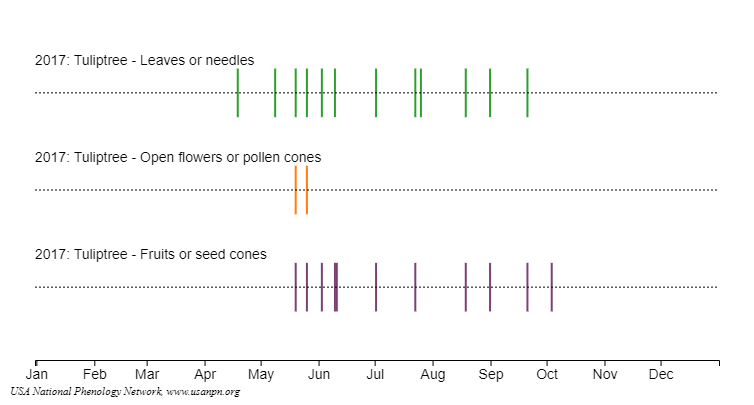
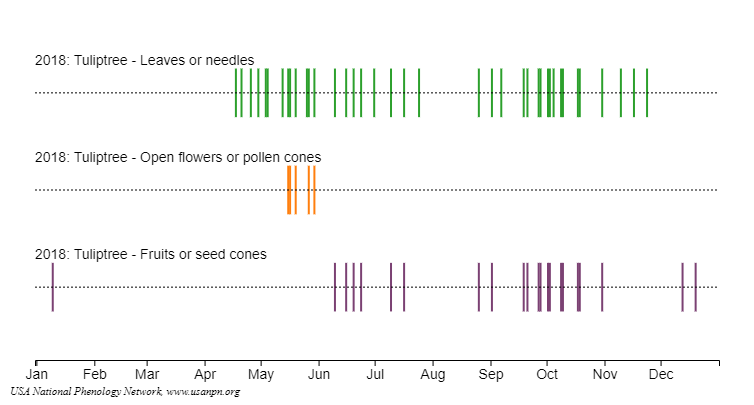
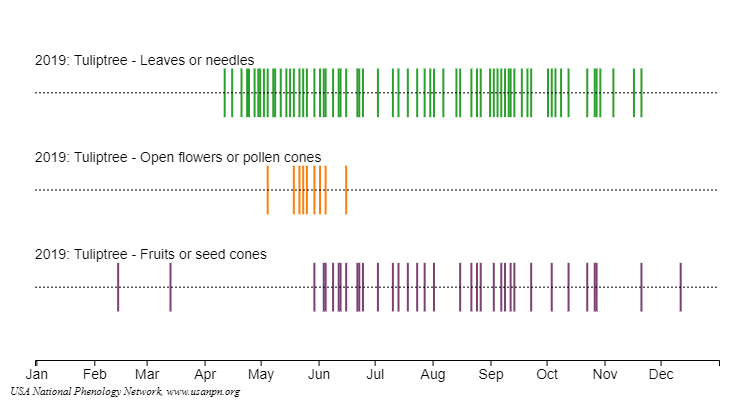
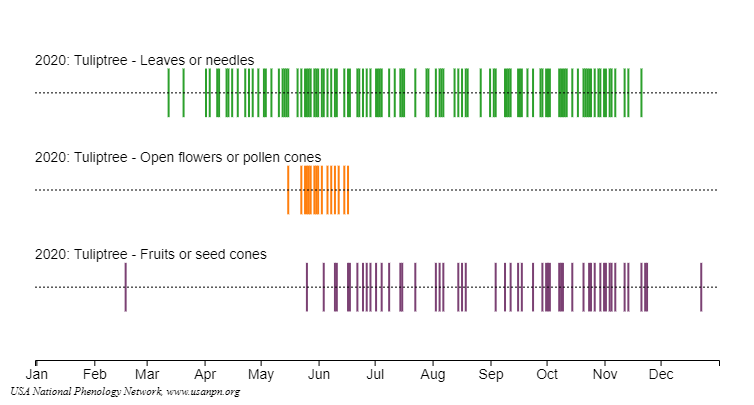
Liriodendron tulipifera is Indiana’s state tree.
The tulip poplar is planted for reforestation purposes because of its rapid growth and the commercial importance of its wood, and is often planted as an ornamental.
This species has some wildlife value. The fruits provide food for squirrels in the late fall and winter months, and the white-tailed deer often browse on the twigs.
How to Identify
LEAVES large, dark green and triangular, with coarsely toothed edges. The stem (petiole) is flat.
TWIGS grayish-yellow and stout, with large triangular leaf scars
FLOWERS dioecious. Male trees have dangling, reddish catkins before leaves appear. Female flowers are yellow.
FRUIT dangling clusters of hard green capsules (on female trees only). Each seed produces a bit of fluff to aid in wind dispersal.
YOUNG BARK silvery-white, smooth, or lightly fissured
AGED BARK dark gray and deeply fissured
MATURE HEIGHT of 65–195 feet
MATURE TRUNK diameter of 8-9 feet
Leaves
Flowers
Fruits
Leaves
A leaf bud is considered “breaking” once a green leaf tip is visible at the end of the bud, but before the first leaf from the bud has unfolded to expose the leaf stalk (petiole) or leaf base. A leaf is considered “unfolded” once its entire length has emerged from a breaking bud, stem node or growing stem tip, so that the leaf stalk (petiole) or leaf base is visible at its point of attachment to the stem. A leaf is considered to be “increasing” until it reaches its full size. A leaf is considered “colored” when it shows some typical late-season (fall) color, or yellow or brown due to drought or other stresses.
Flowers
The flower or flower buds stage begins when tightly closed buds begin to actively swell or expand. Flowers are considered “open” when the reproductive parts (male stamens or female pistils) are visible between or within unfolded or open flower parts (petals, floral tubes or sepals).